
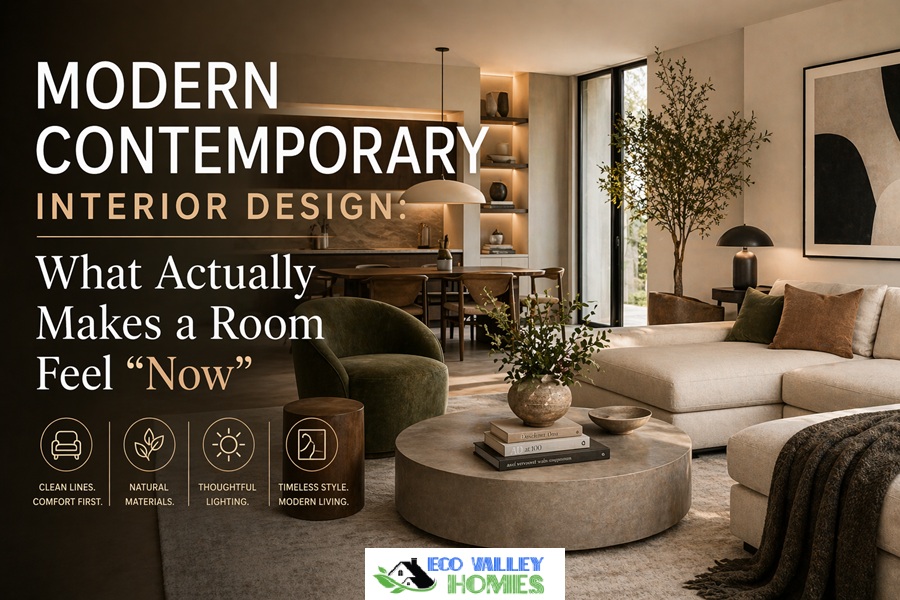
Walk into any well-designed home in 2026 and you can feel it before you can name it. The room is calm but not cold. There’s restraint, but also a plush chair you want to sink into. Nothing screams for attention, yet everything holds up when you look closer. That’s modern contemporary interior design doing its job — and it’s a specific, learnable discipline, not a vibe you either have or don’t.
The confusion starts with the name. “Modern” refers to a specific movement rooted in the early-to-mid 20th century — Bauhaus, Eames, Le Corbusier, clean geometry, functional purity. “Contemporary” means right now, whatever right now happens to be. Modern contemporary interior design is the marriage of the two: the discipline of modernism’s bones with the softness, warmth, and cultural mix of the present moment. Done well, it looks effortless. Done badly, it looks like a furniture showroom after hours.
Here’s how to actually pull it off.
The Core Principles That Hold Every Room Together
Restraint as a design tool, not a limitation
The biggest mental shift in contemporary design is understanding that negative space is a design element. A sofa with two feet of breathing room on either side looks more expensive than the same sofa crammed between two side tables. An empty wall next to a single framed piece lands harder than a gallery wall of twelve.
The psychological reason: your visual cortex processes empty space as “this room has been considered.” Cluttered rooms make the brain work to find the point. Restrained rooms give the eye a clear path.
The 60-30-10 color discipline
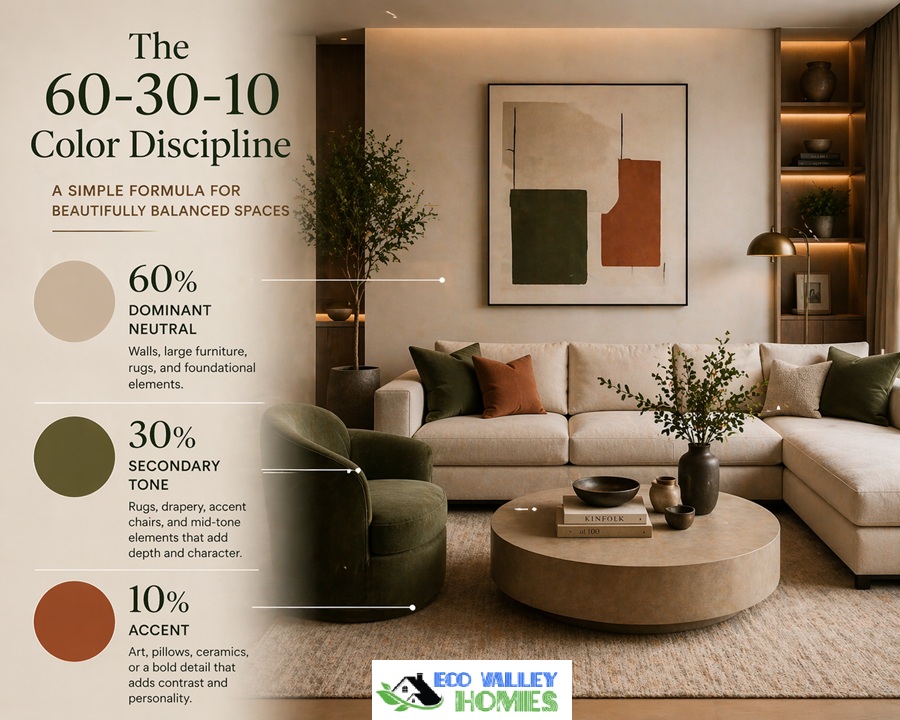
Contemporary interiors hold together because they follow a color ratio, whether consciously or not: 60% dominant neutral (walls, large furniture), 30% secondary tone (rugs, drapery, accent chairs), 10% accent (art, ceramics, a single bold textile).
What changed in 2026 is the palette itself. The cool greys of 2018 are gone. We’re in the era of warm neutrals: plaster, oat, mushroom, clay, smoked oak, soft mocha. The secondary layer trends toward moss, terracotta, rust, and dusty olive. The 10% accent is often unexpected — a single aubergine velvet pillow, a piece of chartreuse glass, a painting with a single cadmium red slash.
Furniture that does less, but does it beautifully
Contemporary pieces are defined by what they leave out. No fussy skirts on sofas, no carved legs, no ornamental hardware. But — and this is the shift from strict minimalism — they’re allowed to be soft, curved, and tactile. The bouclé cloud sofa. The sculptural pedestal dining table. The low-slung swivel chair. The current aesthetic forgives curves in a way 2015 contemporary design did not.
Room-by-Room Playbook
The living room: anchor, soften, disrupt
Start with the anchor — usually the sofa. In 2026, the dominant silhouette is a deep, modular, low-backed sofa in a warm neutral (ivory, oat, camel, or a deep mocha). Avoid the matching loveseat. Contemporary design pairs unlike pieces that share proportions, not identical twins.
Soften with rugs and drapery. A thick wool or jute rug in a tonal pattern. Linen drapery that puddles slightly on the floor — never stops above the baseboard, which reads dated instantly.
Disrupt with one unexpected object. A vintage Pierre Jeanneret-style chair in teak. A travertine coffee table with raw, chiseled edges. A large ceramic vessel from a small maker. This is where personality enters — contemporary design without disruption looks like a hotel lobby.
Budget-friendly version: IKEA’s Söderhamn or Kivik modular sofa in a beige performance fabric, a tonal tufted rug from Ruggable, linen curtains from H&M Home, and one vintage Facebook Marketplace find as the disruptor.
Premium version: A Gubi Pacha or Flexform Groundpiece sofa, a handwoven Beni Ourain rug, Belgian linen drapery, and a signed piece of contemporary ceramic art.
The kitchen: surfaces doing the talking
Contemporary kitchens in 2026 have moved decisively away from all-white. The current formula is warm wood lowers + pale stone uppers or open shelving + a single statement material — fluted oak, burl veneer, or honed stone running floor-to-ceiling on the backsplash wall.
Hardware is either invisible (push-to-open) or sculptural (unlacquered brass in organic shapes). The fridge is panel-ready or built-in. Visible appliances are a contemporary no-go unless they’re intentionally sculptural — a La Cornue range, a vintage SMEG reading as a wink.
The bedroom: the hotel suite principle
The contemporary bedroom borrows from luxury hotels: bed floated in the room with symmetry on both sides, oversized lamps, layered bedding in three or four tonal whites and oats, no television, no visible technology. A single piece of large-scale art above the bed instead of multiple frames. Drapery that blocks light completely and runs wall-to-wall rather than narrowly framing the window.
The bathroom: one hero material
Contemporary bathrooms commit to a single hero surface — microcement, slab stone, or large-format tile — carried through floor, walls, and sometimes ceiling. The vanity floats. Lighting is integrated rather than applied. Fixtures are matte black, unlacquered brass, or aged bronze. The polished chrome era is over.
Style Crossovers Worth Knowing
Contemporary design isn’t one look; it’s a framework that absorbs other styles gracefully.
- Japandi contemporary: Blends Japanese wabi-sabi restraint with Scandinavian warmth. Low-profile furniture, natural oak, cream walls, handmade ceramics, a single ikebana arrangement. Works beautifully in small apartments.
- Warm minimalist: The dominant direction right now. Strips the coldness from traditional minimalism by adding plaster walls, textured linens, and curved silhouettes. Instagram-friendly but actually livable.
- Quiet luxury contemporary: Contemporary bones with genuinely expensive materials — Calacatta Viola marble, bronze hardware, cashmere upholstery — but deployed sparingly. The flex is subtlety.
- Boho contemporary: Layered textiles, collected objects, plants, and global pieces against clean architectural backgrounds. The architecture stays modern; the styling brings the warmth.
- Scandinavian contemporary: Pale woods, whites, functional furniture, generous natural light. Pragmatic and unpretentious.
Pick a lane, or blend two. Blending three usually produces noise.
The Design Psychology — Why This Actually Works
Contemporary design succeeds because it respects how human attention operates. Three principles do most of the work.
Cognitive ease. Brains prefer environments where information is organized. Contemporary design delivers that through visible order — aligned edges, consistent proportions, limited color — which reduces what psychologists call “cognitive load.” You literally relax faster in these rooms.
The Goldilocks contrast principle. Too much visual contrast (stark black and white) keeps the eye jumping. Too little (all beige everything) reads flat. Contemporary palettes sit in the middle zone, where the eye can rest but isn’t bored.
Tactile richness as compensation. When you strip visual ornament, the brain seeks stimulation through texture. That’s why contemporary rooms layer bouclé, linen, wool, stone, leather, and raw wood. Touch compensates for what sight gives up.
Mistakes Even Experienced Stylers Make
- Matching furniture sets. A three-piece “living room set” reads instantly dated. Mix silhouettes and finishes that share scale, not identity.
- Area rugs that are too small. The rug should sit under at least the front legs of every seating piece. A tiny rug floating in the middle of a room makes the whole space look cheap.
- Art hung too high. Center of the artwork belongs at 57–60 inches from the floor (museum standard). Most people hang art 6+ inches too high.
- Overhead lighting as the main source. A single ceiling fixture flattens a room. Layer floor lamps, table lamps, and sconces — minimum three light sources per room, all on warm bulbs (2700K or below).
- Decorative objects in odd numbers of three, everywhere. The “rule of three” became a formula and now reads generic. Break it deliberately — pairs and solos look more intentional in 2026.
- Faux plants. Contemporary design depends on the imperfection of living things. A single real olive tree or fiddle-leaf fig does more than ten silk arrangements.
- Everything arriving at once. Rooms that were bought in a single weekend look like it. Contemporary interiors should accumulate — add vintage, handmade, and collected pieces over time.
Frequently Asked Questions
What’s the difference between modern and contemporary interior design?
Modern design refers to a fixed historical movement (roughly 1920s–1970s) with defined principles: clean lines, functionality, industrial materials. Contemporary design is whatever is current — it shifts every few years. Modern contemporary design blends the two: modernist discipline with present-day warmth and materials.
Is contemporary interior design expensive?
It doesn’t have to be. The core principles — restraint, tonal palettes, good proportions, layered lighting — cost nothing to apply. A thoughtfully edited IKEA living room can look more contemporary than a poorly styled designer room. Money helps with specific materials (stone, solid wood, handmade ceramics), but taste and restraint matter more.
What colors work best for modern contemporary interiors in 2026?
Warm neutrals dominate: plaster, oat, mushroom, clay, smoked oak, mocha. Secondary tones include moss, terracotta, rust, and dusty olive. Avoid cool greys, stark whites, and high-contrast black-and-white schemes — they read distinctly 2015–2019.
Can I mix contemporary design with vintage pieces?
Absolutely — and you should. A single vintage or antique piece in an otherwise contemporary room creates the “disruption” that gives the space soul. The key is contrast in era but harmony in scale and palette.
What’s the easiest way to make a room feel more contemporary without renovating?
Three moves do most of the work: swap ceiling light for layered lamps, replace heavy drapery with floor-puddling linen, and remove at least 30% of whatever is on your surfaces. Restraint plus warm light transforms rooms faster than any furniture purchase.
The Takeaway
Modern contemporary interior design isn’t about chasing trends or buying the right sofa. It’s a set of disciplines — restraint, proportion, tonal palettes, layered texture, deliberate disruption — that you can apply to a 400-square-foot rental or a 4,000-square-foot house with equal effect.
The test is whether the room still looks good when nothing is happening in it. No flowers on the table, no throw draped artfully, no natural light streaming in. Just the bones. If the bones hold up, you’ve done contemporary design right. The styling is just the last 10%.
That’s the whole game. Get the fundamentals right, buy slower, edit harder, and let the room breathe.